Edinburgh Castle rises as though the city’s own consciousness had hardened into stone. It does not merely occupy the skyline, it organizes it. From below, the fortress appears less like an isolated building than like an inevitable outcome — a final clause written first by geology and only later annotated by history. Yet its architecture cannot be understood as a single, stable statement preserved across time. Rather, it must be read as a stratified construction, a palimpsest of interventions in which successive centuries deposited their own material logic, political priorities and symbolic investments. Its fabric is sedimentary in both literal and conceptual terms. To look at Edinburgh Castle, then, is not simply to see architecture, but to read duration in stone: to witness how topography, military necessity, royal ideology, restoration practice and national memory have each left their distinct pressure on the same mass of rock.
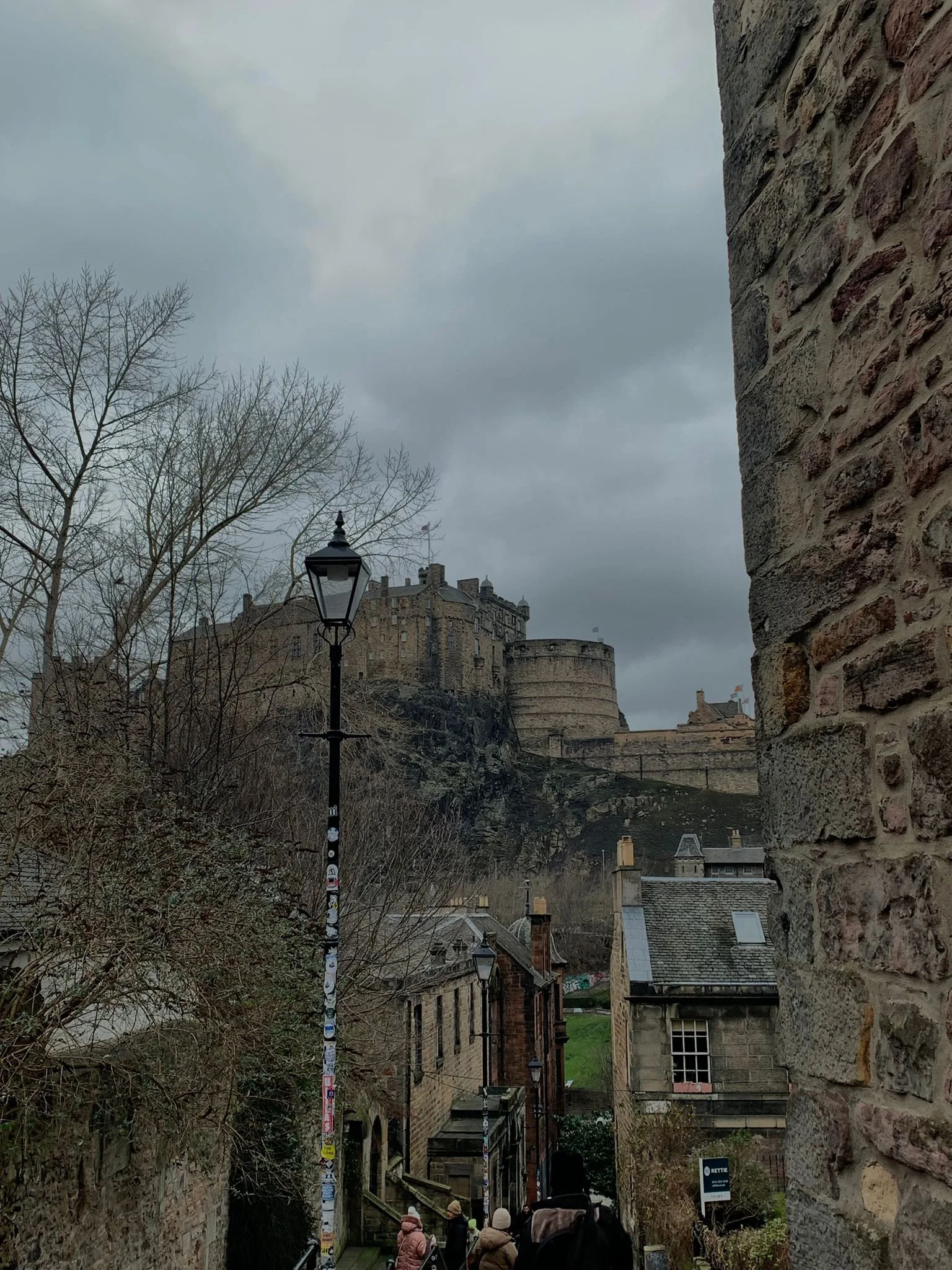
The first and most fundamental layer is the one no human designed: Castle Rock itself. A volcanic plug, abrupt and dark against the surrounding urban field, it constitutes the castle’s primary architectural condition. Before walls, towers or ceremonial interiors, there was this geological fact — a verticality that transformed the surrounding terrain into something exposed, subordinate and defensible. In art-historical terms, the site is not merely a pedestal for architecture, it is an active generator of form. The castle does not simply sit upon the rock, nor does it merely adapt to it. It appears to continue it. Walls rise with such apparent inevitability from the cliff face that the distinction between natural formation and human construction begins to blur. This fusion is crucial. It signals an architectural relationship to site that is not picturesque or ornamental, but structural and determinative.
Nevertheless, the steep gradients, restricted approaches and sweeping visual command offered by the rock were not supplementary features added to a design. They were the design’s first constraints, its governing logic. The terrain dictates, where entry is possible, where defense is strongest, where masonry can rest, and where it must cling, brace or thicken. In this sense, the ground is not passive support, but an active force within the composition. One might even say that Castle Rock functions as the castle’s original author, establishing the terms to which every later builder was required to respond. The architecture emerges not from free invention, but from negotiation with a preexisting mass, whose authority could not be ignored. The site, therefore, is not neutral backdrop. It is argument, resistance and opportunity at once.
The next layer, human-made, yet still ancient in sensibility, extends that geological argument into the language of medieval fortification. Medieval military architecture is above all an architecture of mass. Its values are thickness, continuity, enclosure and endurance. It does not seek transparency or lightness and it does not privilege aesthetic coherence in the later Renaissance sense. Instead, it produces authority through weight. At Edinburgh Castle, this logic is legible in the defensive preference for broad wall planes, guarded apertures, controlled circulation and an overall spatial rhetoric of resistance. If later centuries would increasingly stage the castle as image, monument and symbol, the medieval layer treats it first as a machine for survival.
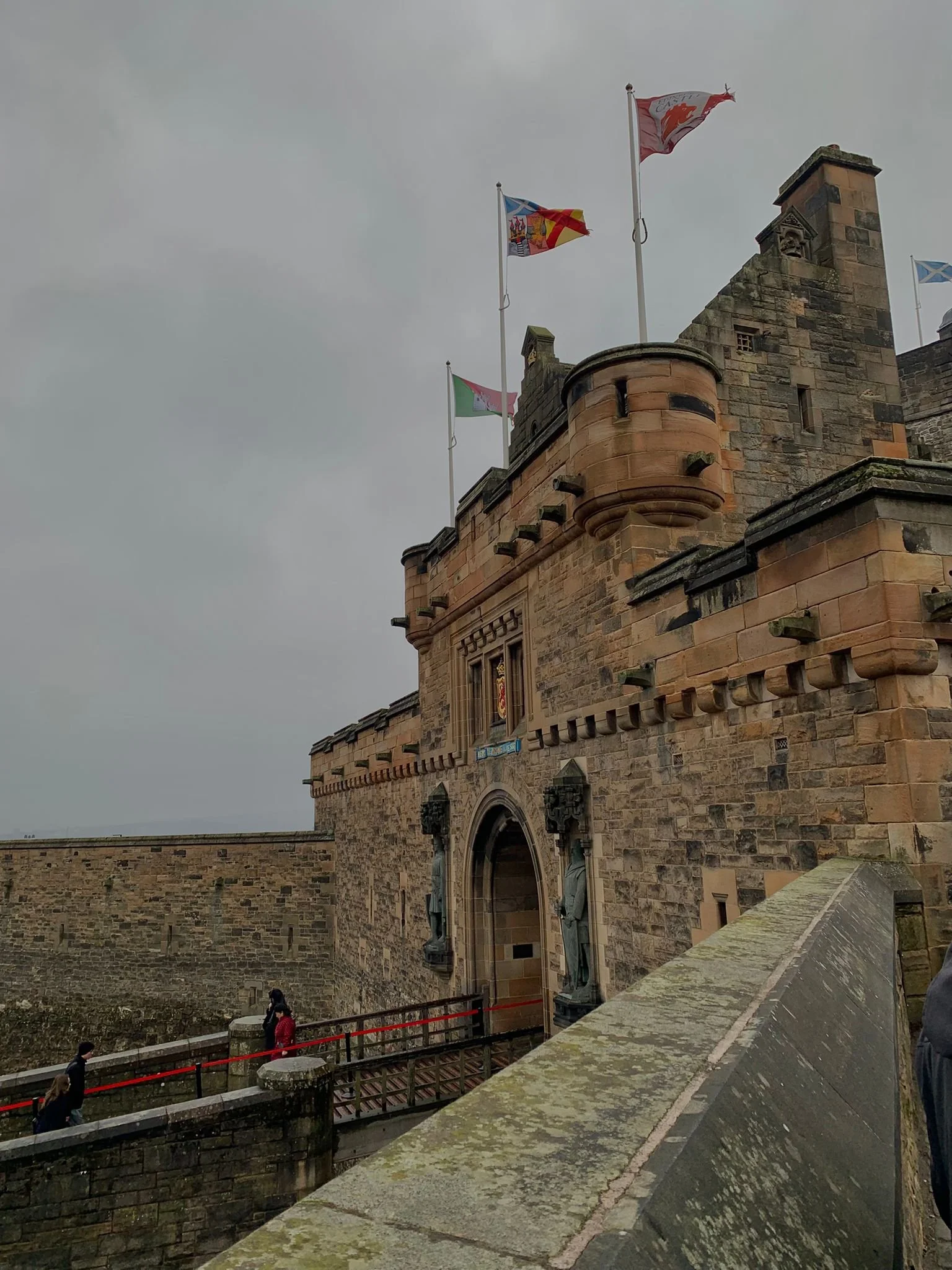
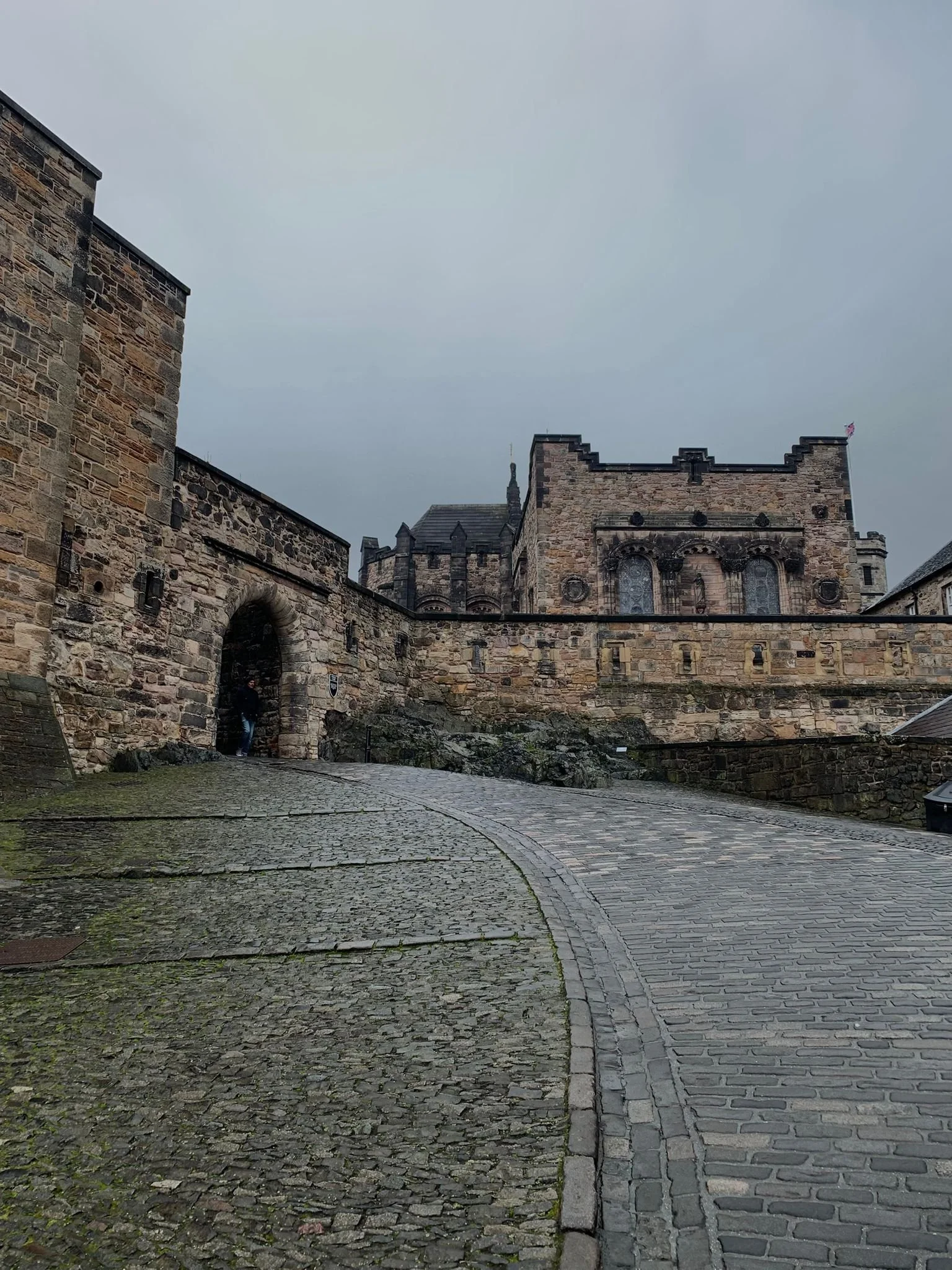
This is what gives the medieval stratum its particular psychological power. A thick wall is never only a technical solution. It is also ideological theater. It materializes a message: that assault will be delayed, energy expended and violence absorbed. Medieval defensive architecture operates through more than obstruction, it operates through intimidation. It translates military preparedness into a sensory experience. One feels this most clearly in the management of movement. Approaches narrow, entrances compress and transitional spaces expose those who pass through them. Architecture here disciplines the body. It slows advance, channels direction, restricts freedom of motion and maximizes visibility for those within, while minimizing security for those without. Even without cataloguing every gatehouse or defensive tower, one senses the logic of fortification in the ascent itself. The castle does not passively await attack. It spatially anticipates it. It is built on the assumption that conflict is not exceptional, but normal.
Yet no fortress remains purely medieval, because the technologies of war do not remain still. A further layer must be read into the castle through its adaptation to artillery. The arrival of gunpowder weaponry fundamentally altered the logic of defense throughout Europe and Edinburgh Castle was no exception. Once cannon fire became decisive, verticality alone no longer guaranteed security. Height could expose as much as protect and stone walls once thought invulnerable could be fractured by repeated bombardment. Architectural response therefore had to become more calculated, more materially self-aware. Defenses were thickened, platforms adjusted, lines of fire reconsidered and the outer body of the fortress reworked according to a new ballistic intelligence.
This phase is particularly revealing, because it demonstrates architecture under technological pressure. Here, the castle registers a shift from a medieval confidence in static mass to an early modern awareness of impact, range, trajectory and shock. One could say that the architecture acquires a new physics. The forms become, in places, more grounded and muscular — less invested in sheer vertical assertion and more in engineered resistance. The emotional character shifts as well. If the earlier fortress can seem stern and watchful, the artillery-adapted castle often feels clenched, compressed and braced against a more violent future. This is not stylistic change for its own sake. It is formal transformation compelled by new conditions of threat.
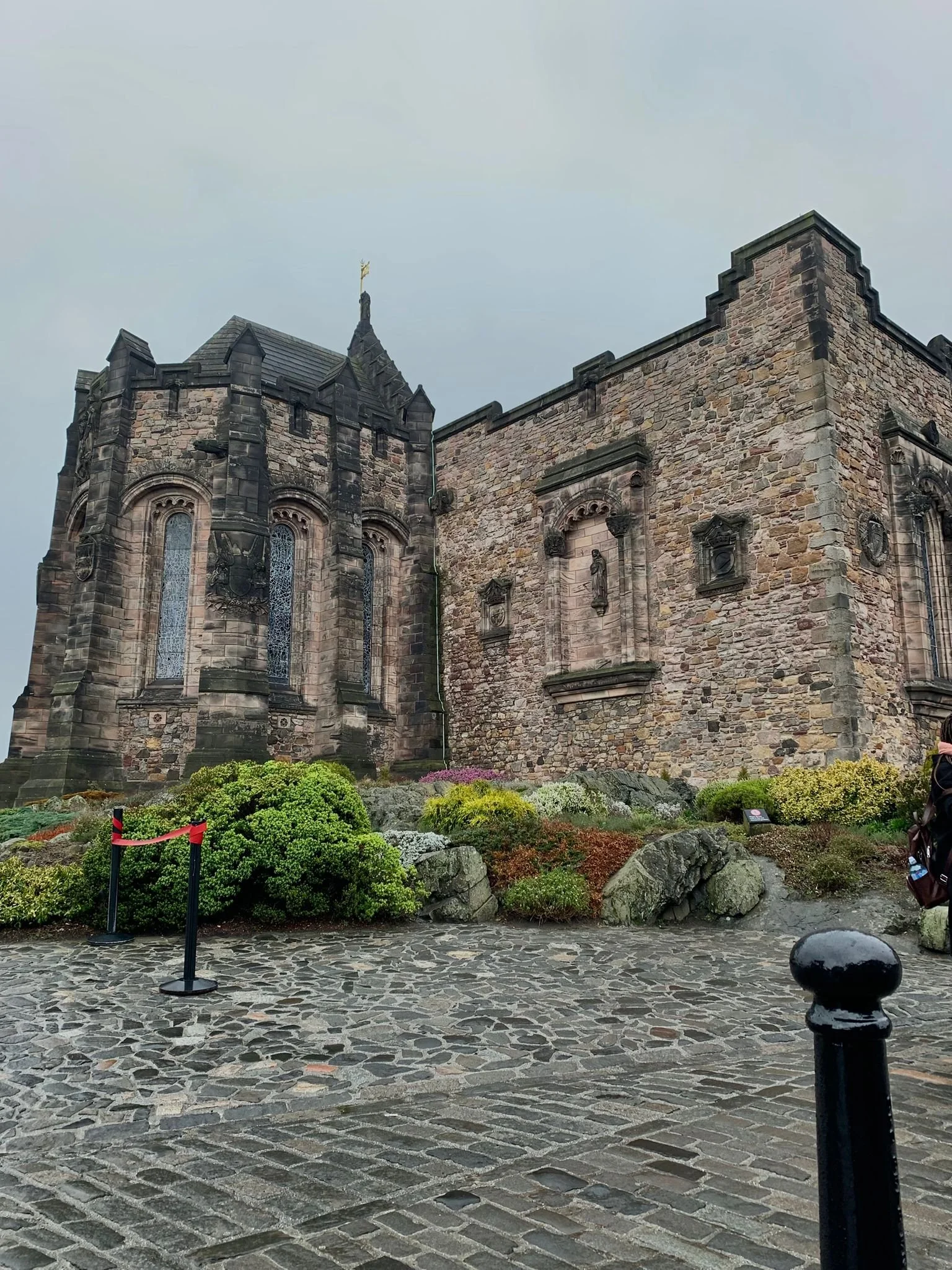
What makes Edinburgh Castle so compelling from an art-historical perspective is precisely that it is not a unified work in the conventional sense. It is not “a style” preserved intact, nor does it conform neatly to one period label. Its architectural identity lies instead in accretion, adaptation and coexistence. Each phase arrives with its own practical logic and symbolic language, yet none completely erases, what came before. Medieval walls remain beside later reinforcements, old defensive assumptions survive even as new technologies alter them. The result is not seamless harmony, but a kind of coherent tension. The visible seams between eras are not imperfections in the monument’s legibility — they are the monument’s truth. Edinburgh Castle is compelling, because it shows history not as a clean succession of replacements, but as a dense layering of unresolved continuities.
Another essential layer is political and ceremonial, rather than strictly military. More than a defensive structure, the castle was also a setting for royal and governmental display, where power was asserted through space and ritual. This introduces a different architectural logic. If fortification seeks to delay, obstruct and absorb, ceremonial architecture seeks to frame, elevate and persuade. Official halls and spaces of assembly do not merely accommodate rituals of power, they participate in producing them. They are spatial instruments through which authority becomes legible and hierarchy becomes experiential.
In this register, architecture operates as choreography. It organizes entrances, orchestrates lines of sight and places bodies in meaningful relation to one another. It creates settings in which legitimacy appears natural rather than constructed. At Edinburgh Castle, this produces one of the site’s most significant internal tensions: the coexistence of architecture designed to repel and architecture designed to represent. The fortress must protect the crown, but the crown must also be staged as enduring, ordered and inevitable. Even when the material remains stone, the intention shifts. Defensive spaces privilege thickness, shadow and tactical control, ceremonial spaces privilege legibility, arrangement and symbolic clarity. The castle therefore contains not one voice, but several — martial, dynastic, administrative, commemorative — all spoken through related, but not identical architectural forms.
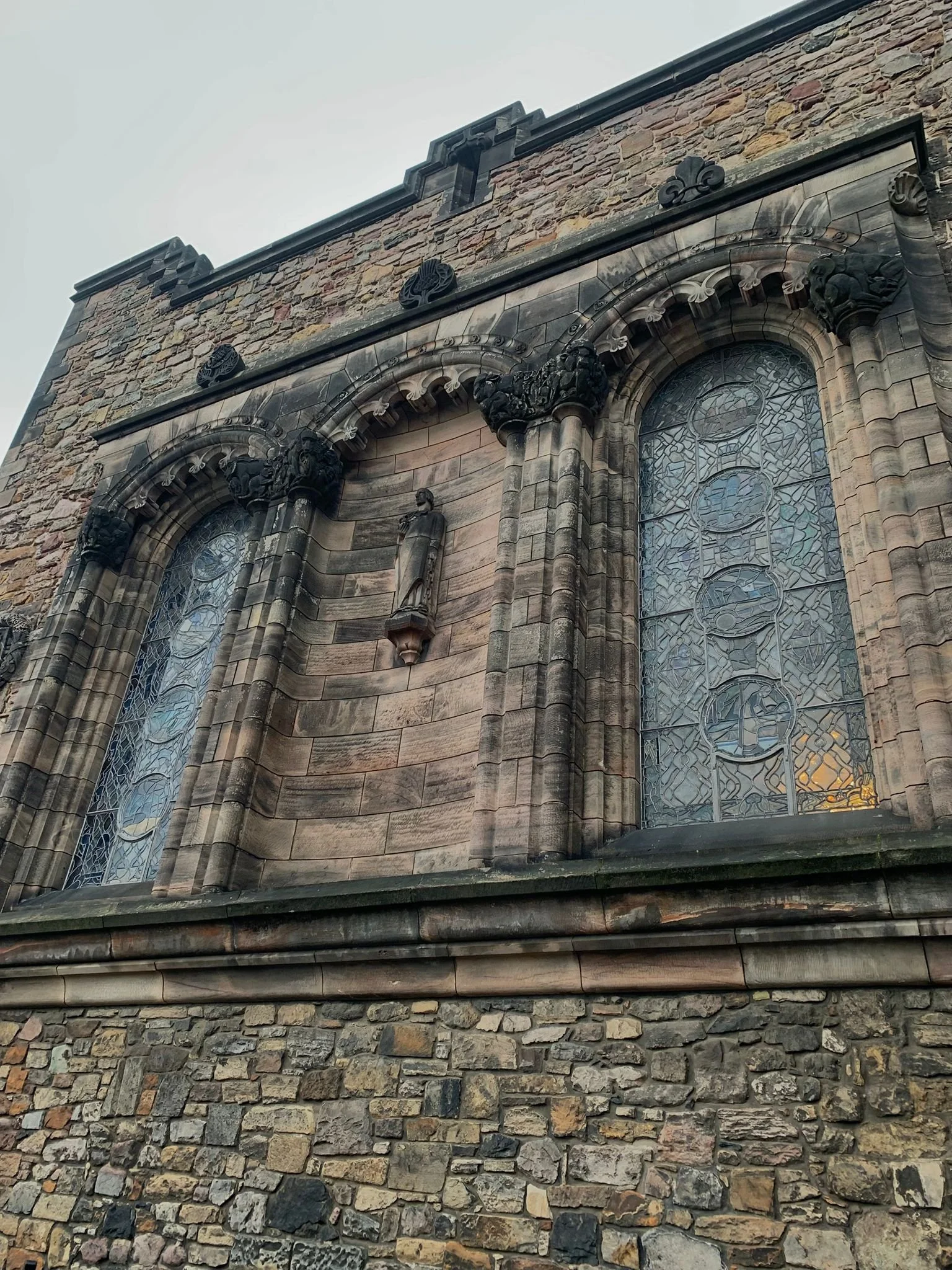
Over time, these layers accumulate not only through new construction, but through modification: repair, reinforcement, demolition, substitution and patching. This is where the sedimentary metaphor becomes especially productive. Sediment is not composed all at once. It gathers incrementally, often through pressure, disruption and repetition. The same is true of the castle’s fabric. Surfaces record damage and healing, masonry joints reveal moments of interruption and continuation, tonal shifts in stone disclose episodes of repair or replacement. Weathering further complicates this reading, softening edges and binding different campaigns of construction into a common visual field, even as close attention continues to distinguish them.
From an art-historical standpoint, these material traces are not secondary details, but primary evidence. They demonstrate that architecture is never only form in the abstract, it is also process made visible. Edinburgh Castle does not narrate its history through inscription alone. It narrates through texture. The stone becomes archival. It retains the memory of fracture, intervention and endurance without needing to verbalize them. In this sense, the monument behaves like a historian, whose method is material, rather than textual. Its archive is lodged in mortar lines, patched facings, uneven surfaces and the subtle disjunctions between one phase of building and another.
Perhaps the most intellectually complex layer is restoration, because restoration is never neutral. It is an architectural practice, but also an interpretive act. To restore a historic structure is not simply to save it from decay, it is to decide, what version of its past should remain visible in the present. Every restoration involves selection. It privileges certain periods, suppresses others, reconstructs what is lost, stabilizes what survives and inevitably imposes contemporary values on inherited fabric. Thus restoration forms another stratum within the castle — one composed as much of ideology as of stone.
This matters profoundly for Edinburgh Castle, because, at a certain point, its identity shifts from strategic stronghold to historic monument. Its value becomes less military than representational. It begins to function as a national image, a carefully maintained emblem of continuity, endurance and Scottish historical consciousness. Under these conditions, the castle is no longer only preserved, it is curated. Its architecture must not merely survive. It must signify. It must appear capable of carrying the weight of collective memory. The paradox of this modern layer is that it is the most recent, yet it often seeks to intensify the affect of antiquity. It restores not simply structure, but feeling: permanence, heroism, endurance, loss, triumph. In doing so, it reveals that monuments are never only inherited, they are continuously remade according to the stories a culture wishes them to tell.
And yet even this curated identity cannot fully silence the earlier layers beneath it. That is the castle’s enduring force. It resists reduction. It is too materially dense, too historically overdetermined, to belong wholly to any single narrative. It has functioned as fortress, royal residence, military installation, prison, symbol and destination. Each of those identities remains partially present in the architecture and none can wholly absorb the rest. To describe the castle simply as “medieval”, “military” or “romantic” is therefore to flatten what is, in fact, a far more complex historical formation. Each label isolates one layer. None captures the entire sediment.
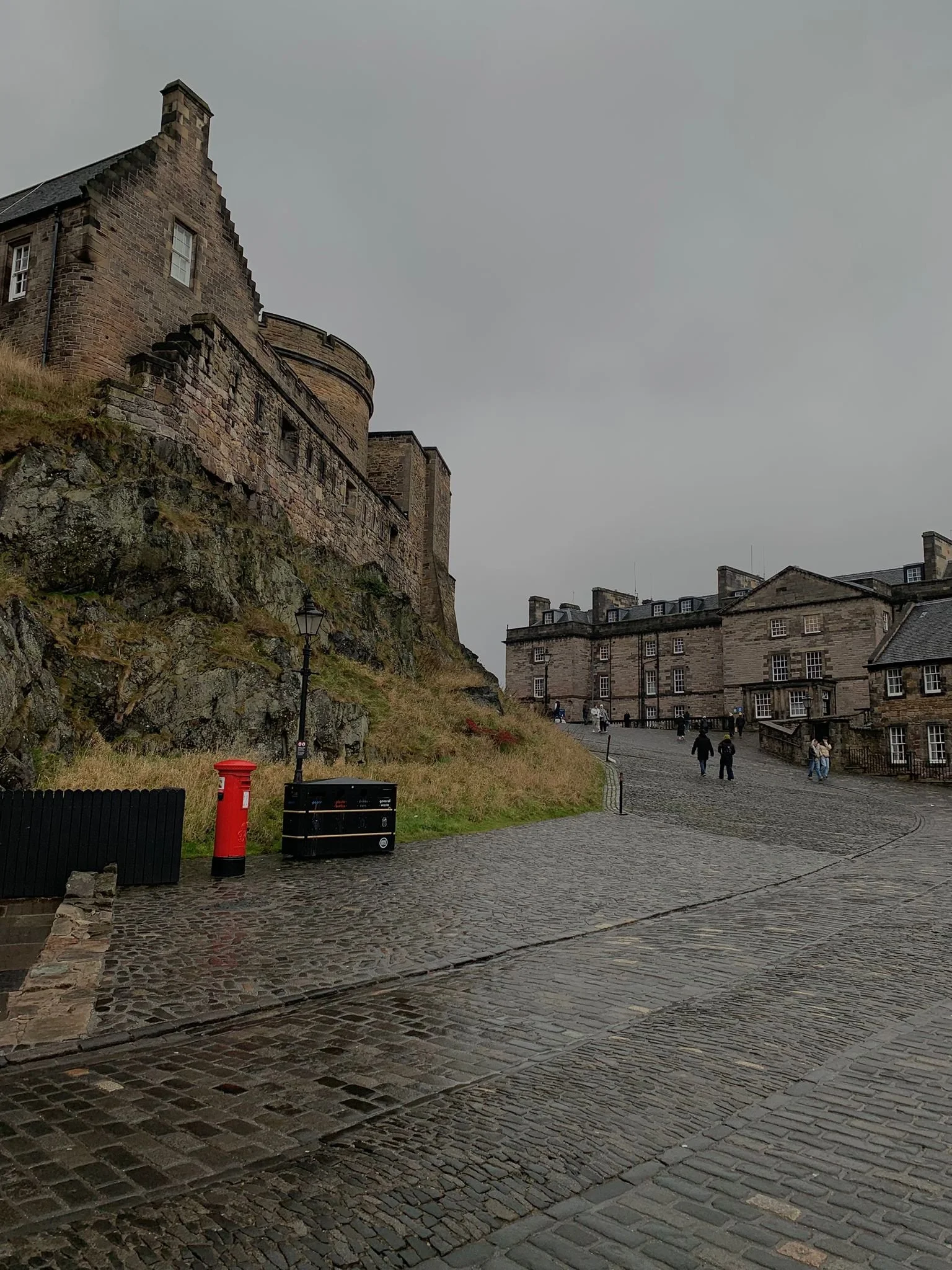
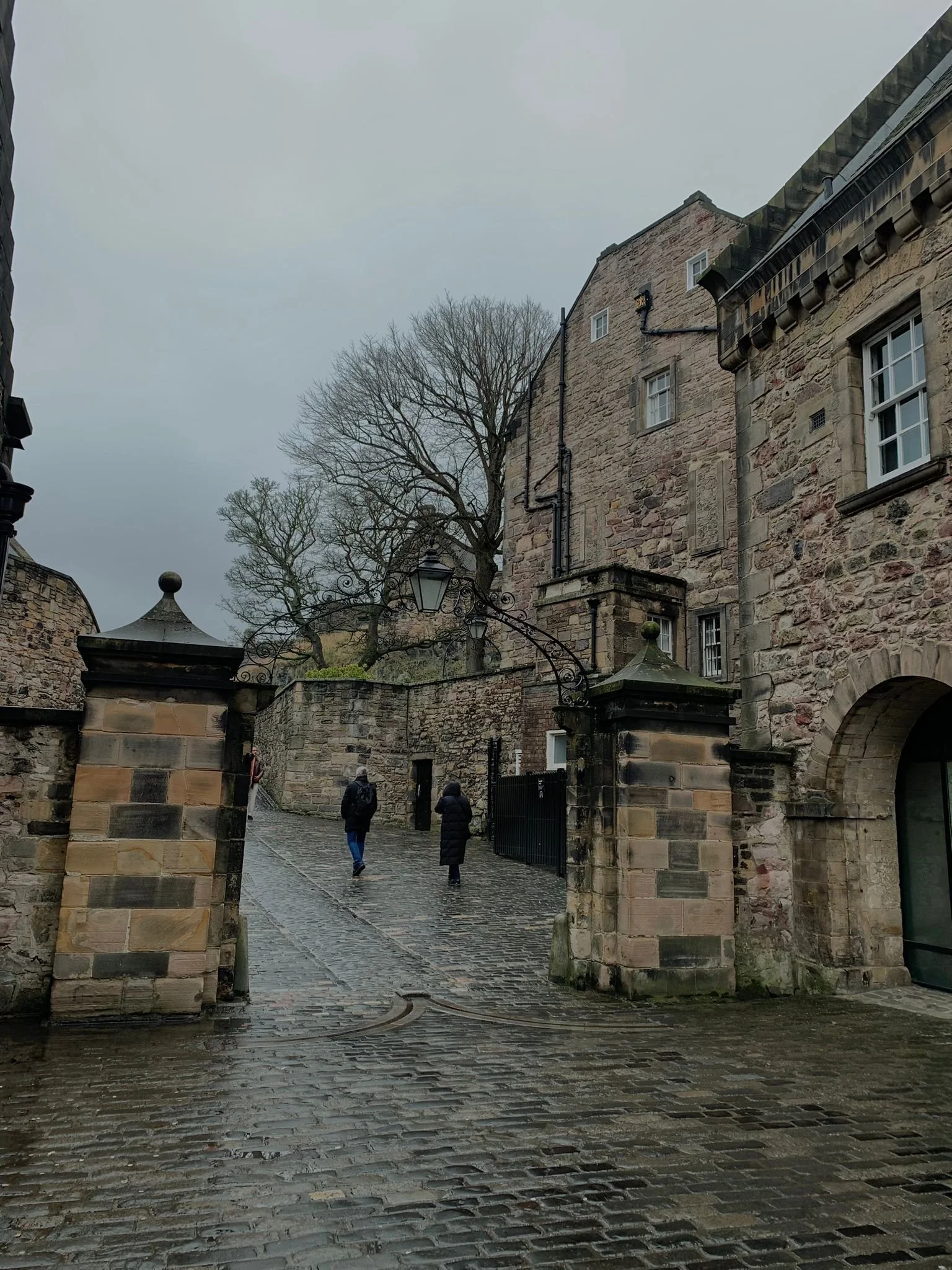
This layering is not only something one observes intellectually, it is something one experiences bodily. To walk toward the castle is to undergo a gradual transformation in spatial perception. The ascent from the city operates almost like a ritual of approach. Urban movement begins to narrow and concentrate. Stone becomes increasingly dominant. Views open and close in measured intervals, producing not full revelation, but suspense. The castle withholds itself as much as it displays itself. This orchestration of partial visibility is central to its power. It constructs anticipation. It compels the viewer into an active relation of looking, approaching and reassessing. One never apprehends the monument all at once. Its scale and complexity resist total possession, forcing instead a sequence of encounters.
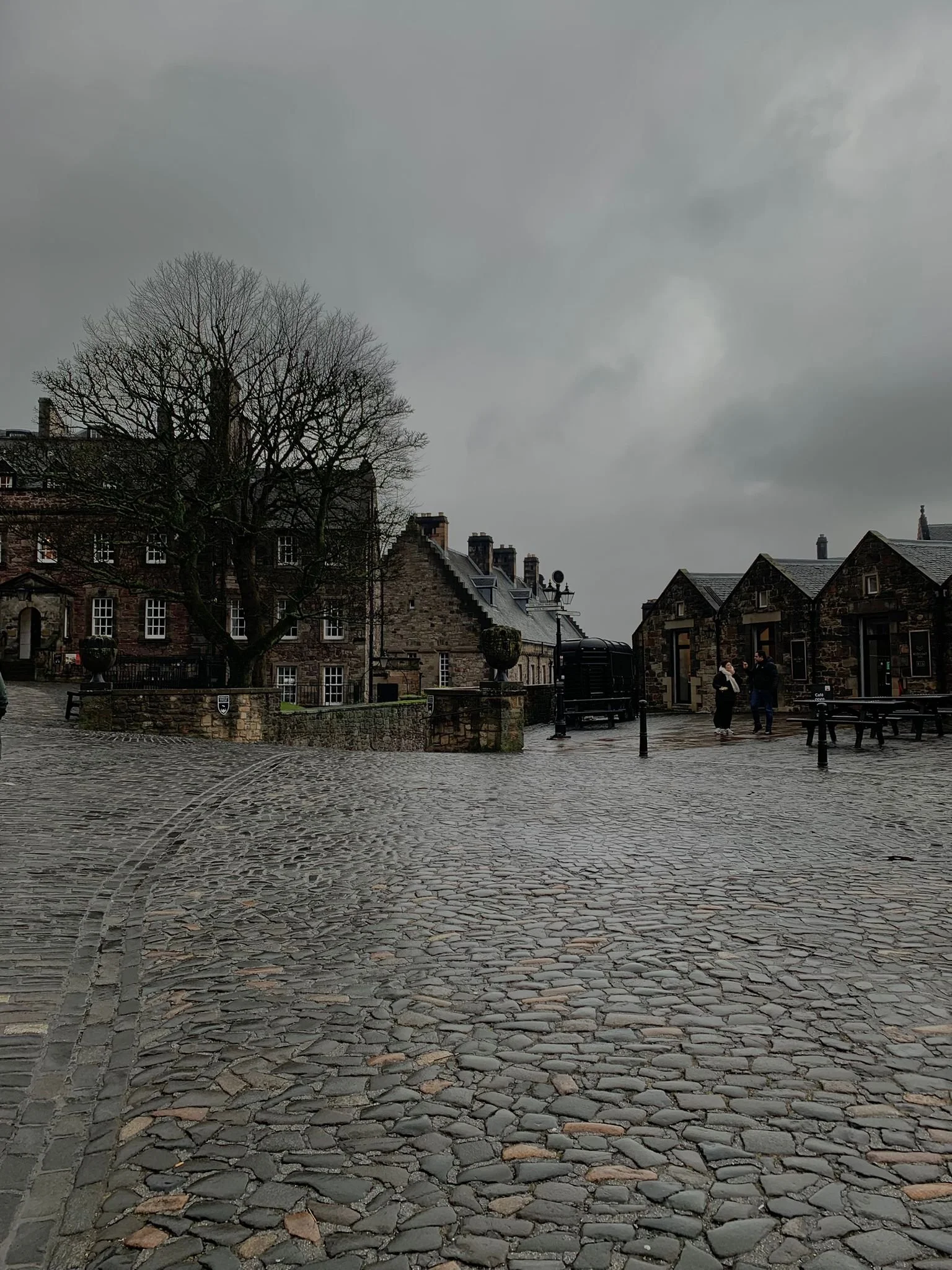
The environment intensifies this instability of appearance. Edinburgh’s weather is not incidental atmospheric setting, but an active participant in the castle’s visual life. Rain darkens the stone and enriches its tonal depth, fog suppresses detail and turns mass into silhouette, intermittent sunlight suddenly articulates edges, joints and textures with almost sculptural precision. The result is that the castle is never visually fixed. It is continually re-authored by climate. From an art-historical perspective, this matters, because it underscores that architecture is not a static object, but a temporal one. Its appearance unfolds in changing light, moisture and season. The monument is therefore not only layered by history, but continually re-layered by perception.
When considered as a whole, Edinburgh Castle emerges not as a singular architectural style, but as a layered organism: geology transformed into fortification, fortification transformed into dynastic theatre, theatre transformed into heritage image. Its walls do not merely define boundaries, they store memory. Its courtyards do not merely contain people, they contain temporalities. Every threat altered its body. Every political need adjusted its stage. Every period of decay prompted a decision about whether, and how, it should continue. So, time did not move around the castle. Time entered it, deposited itself there and remains visible in the structure’s very composition.
For this reason, “Layers of Time, Like Stone Sediment” is not simply a poetic metaphor for Edinburgh Castle’s architecture, it is its most precise critical description. The castle is not a relic sealed within one historical moment. It is a formation, in the deepest sense of the word: built by accumulation, reshaped by pressure and revised by changing cultural conditions. It condenses within a single rocky mass an extraordinary duration of Scottish political, military and symbolic history. What appears immovable is, in fact, the result of repeated change.
And perhaps that is the castle’s deepest significance. It demonstrates that endurance is never purity. Endurance is composite. It is cracked, patched, stabilized and reinterpreted. It survives not by remaining untouched, but by absorbing alteration without surrendering identity. Edinburgh Castle stands not because it escaped time, but because it has been made and remade within time — a continuing negotiation between rock and intention, destruction and repair, use and remembrance. The stone remembers fire, the walls remember conflict, the restored surfaces remember the later hands that refused disappearance. In the joints between centuries, the castle continues to speak — not in one voice, but in many: layered like sediment, dense with history and still, against the moving sky, astonishingly alive.
Coulson, Charles. “Structural Symbolism in Medieval Castle Architecture.” Journal of the British Archaeological Association 42 (1979): 73–101.
Fawcett, Richard. Scottish Architecture: From the Accession of the Stewarts to the Reformation, 1371–1560. Edinburgh: Edinburgh University Press, 1994.
Fawcett, Richard, Iain MacIvor, and Bent Petersen. Edinburgh Castle. Edinburgh: H.M. Stationery Office, 1986.
Fawcett, Richard, and Allan Rutherford. Renewed Life for Scottish Castles. York: Council for British Archaeology and Historic Scotland, 2011.
Gifford, John, Colin McWilliam, and David Walker. The Buildings of Scotland: Edinburgh. Harmondsworth: Penguin Books in association with the National Trust for Scotland, 1984.
Historic Environment Scotland. Edinburgh Castle in the Modern Era: Presenting Meanings. Edinburgh: Historic Environment Scotland, 2019.
Historic Environment Scotland. The Medieval Documents. Edinburgh: Historic Environment Scotland, 2019.
Morris, R. J. “The Capitalist, the Professor and the Soldier: The Re-making of Edinburgh Castle, 1850–1900.” Planning Perspectives 22 (2007): 55–78.
