The Room as Argument: Looking at Romanticism Inside the Scottish National Gallery
There are rooms in museums that feel less like galleries and more like climates. In the Scottish National Gallery’s red-walled spaces, paintings do not simply hang - they converse, compete and echo across gilded frames. This essay is a slow walk through that choreography, looking at how curatorial layout, wall colour, hanging height, spacing, lighting and the placement of sculpture, constructs meaning before we ever reach the wall text. Focusing on the “Romance & Reality: Scotland 1800–1895” displays and the surrounding works as a case study, I trace how the gallery stages nineteenth-century debates around landscape, nation, modernity and the sublime, and how those ideas become something you do not just understand, but physically experience, as you move through the room.
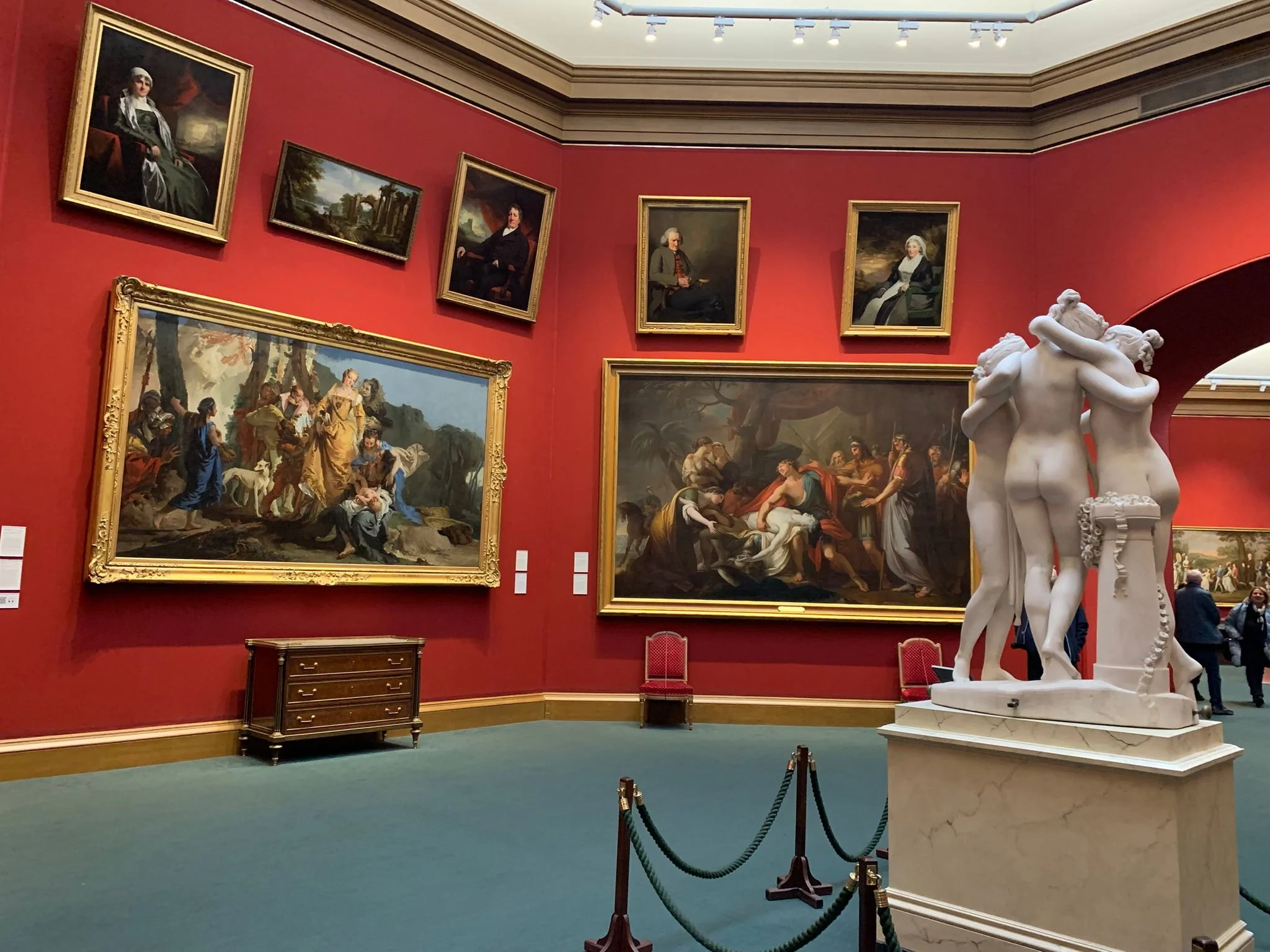
In the Scottish National Gallery, display is an argument: portraits and history painting crowd the red walls, while a white marble group stands at the centre, turning viewing into movement - circling, pausing, returning.
What strikes first is not a single painting, but the wall itself. The deep red of the gallery at the Scottish National Gallery does not behave as a neutral backdrop. It asserts mood. This colour, dense, warm, historically loaded, absorbs light, rather than reflecting it, pulling the viewer inward and slightly slowing the body down as you enter. On a practical level, it does something very specific: it makes pale passages look brighter, it thickens shadows and it turns gold frames into small sources of heat. Against red, gilding does not just “surround” an image - it burns at the edges, heightening the sense that each painting is a contained world with its own temperature.
But the red is also a choice with a genealogy. It echoes the nineteenth-century preference for saturated wall colours in galleries and salons, where display was designed for atmosphere, as much as legibility. In that older museological logic, art was not isolated for clinical study, it was staged for encounter - for gravity, for emotional weight, for the sense that what you were seeing mattered. These walls refuse the modern “white cube” fantasy that artworks float outside time. Instead, they acknowledge the museum as a theatre: a place, where meaning is produced through lighting, spacing, colour and the quiet choreography, of how a viewer moves from one object to the next.
Red, historically, is never innocent. It carries associations of power and prestige (velvet interiors, ceremonial spaces), but also of intensity - blood, fire, passion, drama. In a room devoted to Romanticism and the long nineteenth century, that intensity becomes curatorial rhetoric. It prepares you for artworks that are themselves preoccupied with extremes: overwhelming weather, perilous cliffs, national memory, bodies caught in moral or historical tension. The wall colour does not merely “set off” the paintings, it primes interpretation. It makes the room feel like a register turned slightly higher, as if the museum has decided that this century should not be approached with casual glances.
And it changes, how you look. A dark, saturated wall creates a kind of optical hush around each frame: edges sharpen, silhouettes clarify and intervals between paintings feel deliberate, rather than empty. Even the negative space becomes expressive. The red compresses distance, it makes the room feel closer, more enclosing, more intimate - almost like a chamber, rather than a corridor. You find yourself reading the hang not as scattered objects, but as a sequence, a sentence structure: large canvases as declarations, smaller works as parenthetical asides, sculpture as punctuation that forces the body to pause and reorient.
So the room does not whisper, it speaks in full sentences. Before you’ve read a label, before you’ve committed to any one painting, the gallery has already begun to tell you, what kind of looking is required here: slower, more attentive, more willing to be moved. The wall becomes the first curator - an unseen voice setting tone, insisting that the act of viewing is not passive consumption but a negotiation with mood, history and space.
At the centre of this orchestration hangs Niagara (1857) by Frederic Edwin Church, a work that refuses marginality. Its scale, orientation and placement command the space, forcing the body into a frontal confrontation. Church’s Niagara is not framed as a picturesque view, but as an event - an overwhelming, almost destabilising experience of nature’s force. The waterfall does not recede into landscape, it surges outward, its mist breaking the pictorial plane. Displayed at eye level and surrounded by ample breathing room, the painting is allowed to dominate, mirroring the very subject it depicts.
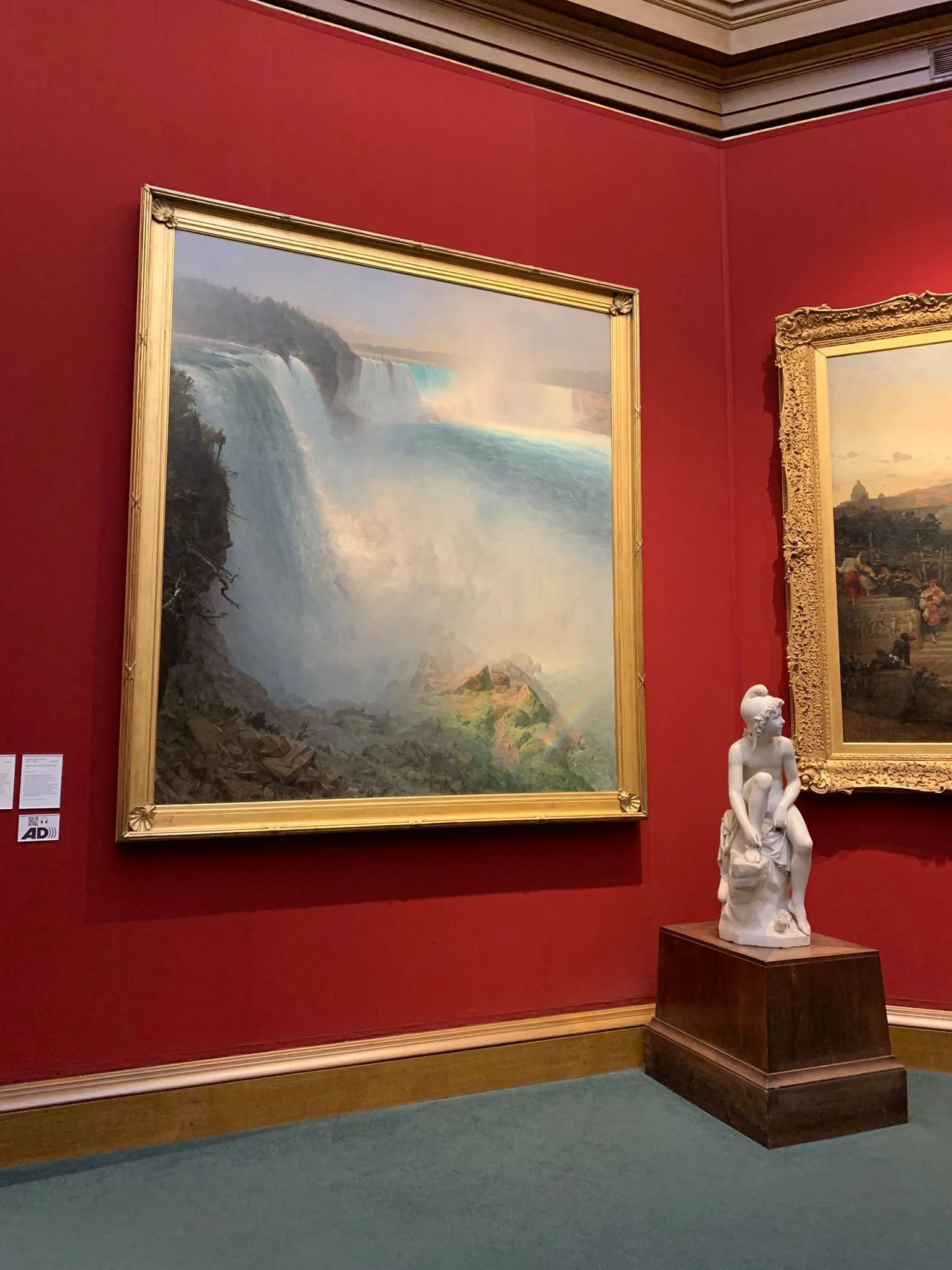
Frederic Edwin Church, Niagara (1857) - mist as architecture, colour as weather and a rainbow so slight it feels like a whispered promise at the edge of force.
And the dominance is not only a matter of size. It is built into the painting’s logic. Church chooses a viewpoint that feels physically risky: the spectator seems to hover near the brink, with no reassuring foreground ledge, no safe terrace. Instead, the picture offers motion as invitation. The river’s surface tilts forward, the current becomes a kind of visual conveyor belt, carrying the eye toward the precipice. In that sense, the composition works like a controlled fall. You do not simply look at the water - you are guided into its momentum. The painted world behaves like a force acting on your body.
The most striking element is the way Church translates violence into clarity. The water is immense, but it is also lucid: cool blues and milky whites are layered in a way that makes turbulence legible, almost architectural. The falls read as a continuous, heavy sheet, while the mist blooms upward like something halfway between weather and breath. This is not the Romantic storm of European painting, dark, theatrical and symbolic, but a newer kind of sublimity, one that borrows from observation and contemporary science. You can sense an era fascinated by optics, by atmosphere, by the measurable mechanics of the natural world - yet still hungry for awe.
That hunger matters historically. In mid-nineteenth-century visual culture, Niagara was not merely a site, it was a modern icon - reproduced in prints, described in travel writing and treated as proof of nature’s scale in the New World. Church’s painting participates in that culture of spectacle, but it also refines it. Rather than giving us a tourist’s overview, he gives us immersion. Rather than offering narrative, he offers sensation. The picture doesn’t say, “Here is Niagara”. It says, “Here is what it does to you”.
This curatorial choice matters. By giving Church’s work spatial authority, the gallery underscores a key tension of the nineteenth century: nature as both spectacle and threat, something to be admired, but never fully mastered. The faint rainbow that fractures the mist at the lower edge of the canvas gestures toward hope or transcendence, but it is fragile, almost swallowed by water and rock. It operates less like decoration and more like a hinge between the physical and the metaphysical: a real optical phenomenon that still reads as promise. In a room framed by “Romance & Reality”, that rainbow becomes especially pointed - a reminder, that even when the century demanded facts, measurement and progress, it still craved meaning.
The museum’s lighting, carefully angled to avoid glare, yet bright enough, to animate the whites and blues, enhances this instability. The upper surface catches light in a way that makes the sky and mist fluctuate, some passages matte and absorbent, others slightly reflective, so the painting seems to change as you shift position. That interaction between paint and illumination quietly echoes Church’s own preoccupation with atmospheric effects: mist is not an object, it is a condition. The gallery’s spotlights make that condition active, almost restless. The painting seems perpetually on the verge of motion - not because it is unfinished, but because it is conceptually alive, built to simulate ongoing force.
Even the surrounding display amplifies the work’s rhetoric. The red wall intensifies the coolness of the water. It makes the blues feel colder and the whites feel whiter. The plain gold frame, comparatively restrained next to more ornate nineteenth-century mouldings nearby, functions like a boundary rather than a distraction: a firm edge holding back something that appears capable of overflowing. Nevertheless, the nearby marble figure, small in comparison, human in scale and material, becomes an accidental, but powerful counterpoint. Against Niagara’s indifferent magnitude, the body reads as fragile and temporary. The gallery, intentionally or not, sets up a dialogue between the human and the elemental: flesh and mist, permanence and force.
In that sense, Niagara becomes the room’s emotional weather system. Other works may offer story, place or character, but Church offers a confrontation with scale - an encounter with something that cannot be domesticated into anecdote. The painting does what the best nineteenth-century landscapes often do: it turns looking into a test. Not a test of knowledge, but of steadiness. You stand there, held by the current of the image, and you realise the museum has arranged the room, so that this is unavoidable: you must face the falls, and in facing them, you feel the century’s obsession with nature, as both theatre and truth.
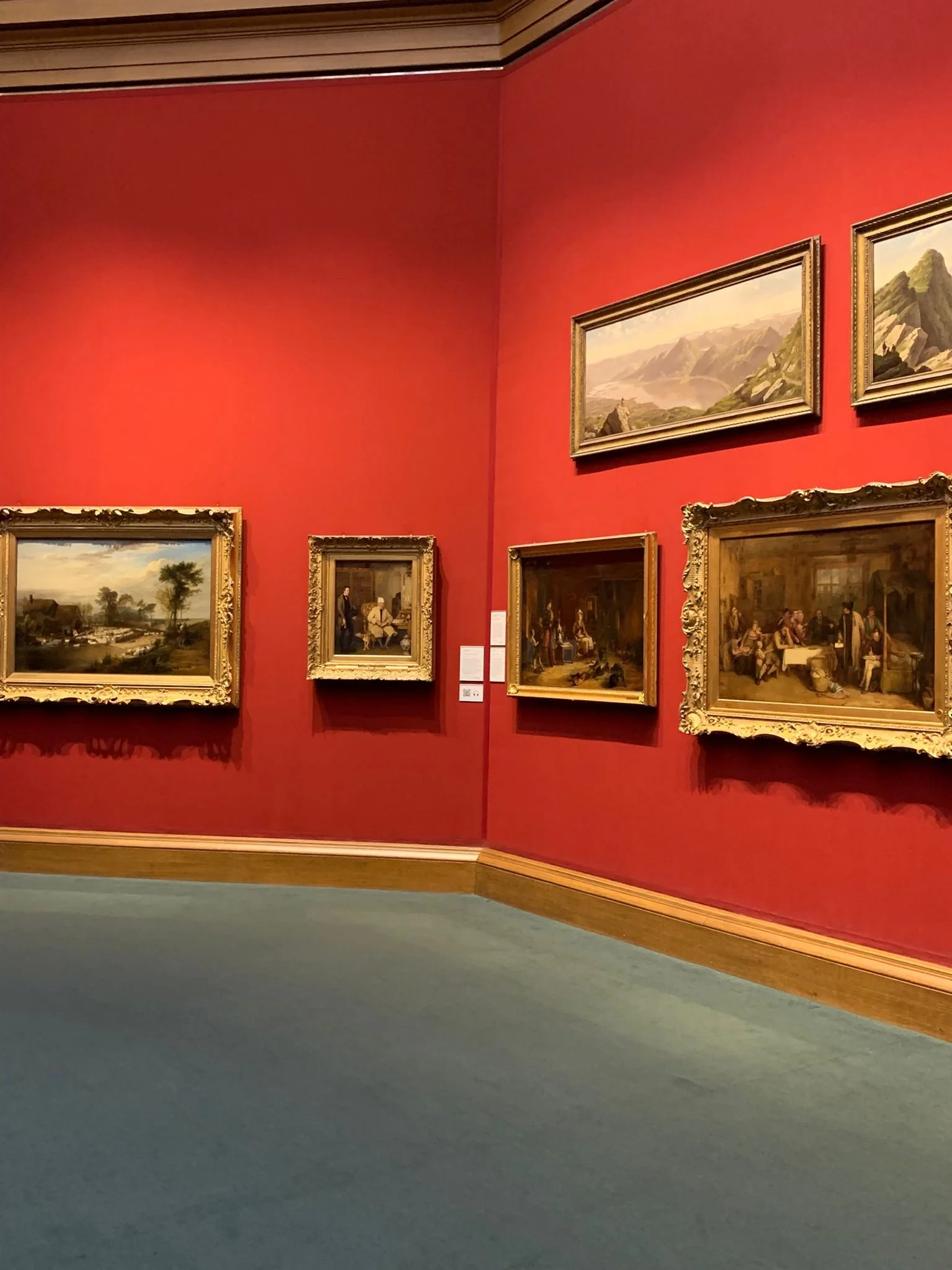
A study in curatorial rhythm: alternating sizes and subjects - landscape, interior, gathering - creates a visual cadence that guides the viewer’s movement across the wall.
Moving through the room, the eye encounters a dense hang of Scottish and European works associated with Romanticism and its aftermath. Landscapes, genre scenes and history paintings cluster along the red walls, framed in gold that catches the light unevenly. This is not a minimalist display, it is a conversation. Smaller works are placed in proximity to monumental canvases, encouraging comparison rather than isolation. The viewer is asked to read across paintings, not just into them.
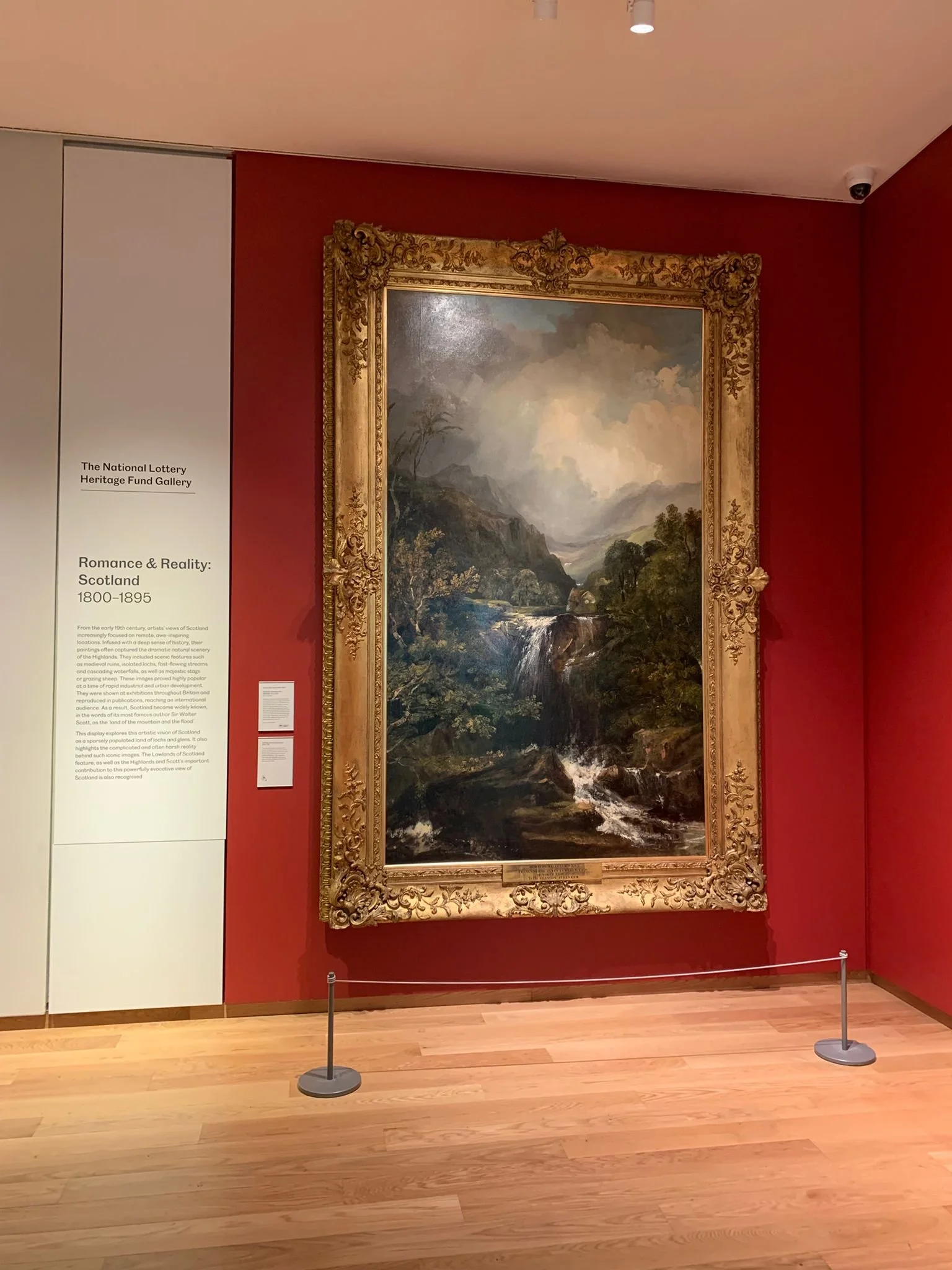
Horatio McCulloch, Highland Landscape with a Waterfall (about 1835) - a “constructed” Highlands made to feel eternal: light opening the valley, water stitching the whole scene into motion. Scottish National Gallery, Edinburgh.
The section labelled Romance & Reality: Scotland 1800–1895 situates these works within a period of profound transformation, one in which Scotland was negotiating the pressures of modernity, while simultaneously constructing a visual language of memory and belonging. The nineteenth century in Scotland was marked by rapid industrialisation, expanding urban centres and new infrastructures that reshaped everyday life. At the same time, Enlightenment rationalism still lingered in intellectual culture, producing a tension between reason and feeling, progress and nostalgia. Romanticism, in this context, is not simply an escape into wild scenery or emotional excess. It becomes a strategy for holding onto what feels threatened. Landscapes absorb the weight of loss-of rural lifeways, of imagined harmony with nature, of older social rhythms displaced by economic and political change.
The gallery layout makes this negotiation visible. Intimate scenes of domestic life and communal gathering are positioned in dialogue with expansive landscapes, as if the room itself were staging a debate between the human-scaled and the overwhelming. The viewer moves back and forth between images that emphasise closeness - interiors, figures, shared labour - and those that insist on distance, altitude and elemental force. This oscillation mirrors a nineteenth-century anxiety: how to situate the individual within a world that feels increasingly vast, abstract and unstable. The hang does not resolve that tension, it sustains it.
Within this argument, Horatio McCulloch’s Highland Landscape with a Waterfall (about 1835) operates like a cornerstone. The National Galleries of Scotland notes that it is McCulloch’s largest known painting and that the scene is “probably imaginary”: a constructed Highlands intended to evoke the magnificence of nature, rather than record a specific place. This matters, because invention here is not a failure of truth - it is a method of iconography. McCulloch is not documenting a site so much as building a national “type”: the Highlands as idea, as emotional geography, as a landscape capable of carrying Scotland’s self-image on its shoulders.
Its civic origin sharpens that reading. The same source records an inscription on the frame indicating the painting was commissioned by James Lumsden, Lord Provost of Glasgow, for a public hall and later incorporated into the interior design of the Glasgow Athenaeum concert hall. In other words, this was made to be seen collectively, in a space of culture and authority, where landscape becomes a public language - something a city can display the way it displays values. The waterfall’s vertical plunge and the mountains’ slow rise behind it are not only natural facts. They become symbols of endurance, gravity and permanence - an image of the nation as ancient terrain, holding steady, while modern life accelerates elsewhere.
Iconographically, the painting stages a carefully managed sublime. The cascade is dramatic but contained, channelled by rock and framed by trees. The viewer is given distance and structure, rather than thrown into sensory overwhelm. That containment is part of the message: nature is immense, but it is also legible - capable of being contemplated, possessed aesthetically, even housed within gilt and civic architecture. The light, too, participates in the rhetoric. It opens the valley toward a softened horizon, a clearing atmosphere that reads almost like providence or promise: not the storm-sublime of terror, but the moralised sublime of uplift. And because the scene is “probably imaginary”, it can be perfected toward that end - edited into coherence, tuned to feeling, made to persuade.
Seen on the Scottish National Gallery’s deep red wall, the painting’s role becomes even clearer. It is no longer just one landscape among others, it reads like a thesis statement in paint: Romanticism as national imagination, landscape as civic emblem and nature elevated, quietly but insistently, into identity.
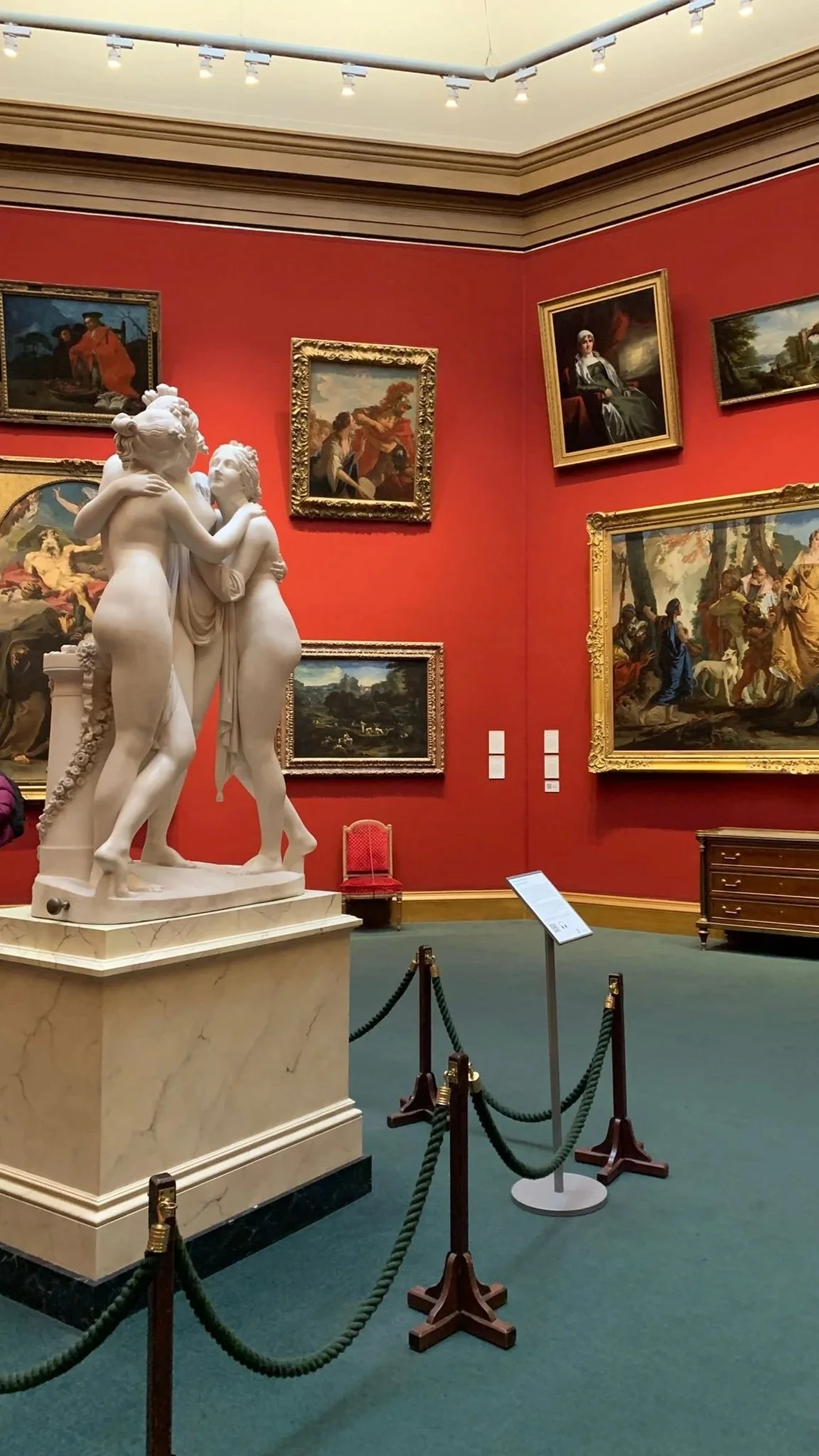
An embrace suspended between steps - skin turned to marble, intimacy turned to monument.
Sculpture, too, plays a crucial role in this spatial choreography. The white marble figures positioned centrally in the room interrupt the viewer’s movement, forcing a physical negotiation of space. Their smooth, idealised surfaces contrast sharply with the textured brushwork of the surrounding paintings. This juxtaposition is not accidental. It stages a confrontation between permanence and flux, between the classical body and the Romantic landscape. As an art historian, I read this as a curatorial decision that foregrounds medium as meaning: paint dissolves into atmosphere, marble insists on form.
Because sculpture is not only something you look at - it is something you move around. Unlike a painting, which keeps its distance and offers a single frontal plane, the marble occupies the same air as the viewer. It claims volume, casts shadow, creates blind spots. It changes the room’s geometry. The gallery’s central placement ensures that no one can drift passively from wall to wall, you have to choose a path, adjust your pace, angle your body, decide what you will give your attention to first. In this way, the sculpture becomes a curator’s tool: it edits sightlines, manufactures pauses and turns viewing into a kind of choreography.
That physical interruption also shapes the psychological rhythm of the room. Romantic landscape painting frequently invites the eye to wander - over rock, cloud, water, distant horizon - letting vision roam and dissolve into atmosphere. Marble denies that wandering. Its edges are definitive. Its contours are non-negotiable. Even when the figure is soft, even when the pose is relaxed, the material asserts a kind of absolute certainty. Light does not get lost in it the way it does in painted mist. It lands, it slides, it clarifies. The viewer experiences a shift from optical uncertainty to tactile conviction, from “what am I seeing?” to “what is this made of?” The body becomes newly aware of surfaces.
There is also an ideological charge in placing classical sculpture among nineteenth-century paintings that are often preoccupied with history, nation and change. The classical figure carries the authority of tradition: an inheritance of ideal proportion, timeless beauty and supposedly universal form. Romanticism, by contrast, often privileges the particular - local landscape, national memory, subjective experience, weather, transient light. Set beside the marbles, the landscapes begin to read not simply as views, but as arguments against timelessness. They insist that meaning is located in place and time, that the world is not stable, that identity is not an abstract ideal, but a lived condition shaped by environment and history.
And then there is whiteness itself - marble’s cultivated pallor - operating like a visual exhale in a room of dense colour. Against the red walls and gold frames, the sculptures act almost like punctuation marks: bright commas of silence within a loud sentence. They gather light and redistribute it. They offer the eye a moment of rest, but also a moment of recalibration. After looking at marble, painted highlights feel less like “brightness” and more like illusion - clever mixtures of pigment that imitate the effects of sun on water or cloud on stone. The sculptures sharpen our awareness that painting is always, in some sense, alchemy: the attempt to create light out of matter that cannot truly shine.
This is why the juxtaposition feels so intelligent. The room becomes a lesson in material thinking. It teaches that art is not only subject matter, waterfalls, histories, faces, but substance and process: oil’s capacity to blur, to glaze, to flicker, marble’s capacity to endure, to hold a contour for centuries. The gallery lets these media correct each other. The marbles remind us of permanence, of the museum’s promise to preserve. The paintings remind us of everything that escapes preservation: weather, time, sensation, the way a landscape looks different each hour. Together they stage a quiet paradox at the heart of the museum itself - an institution built to keep, filled with artworks obsessed with change.
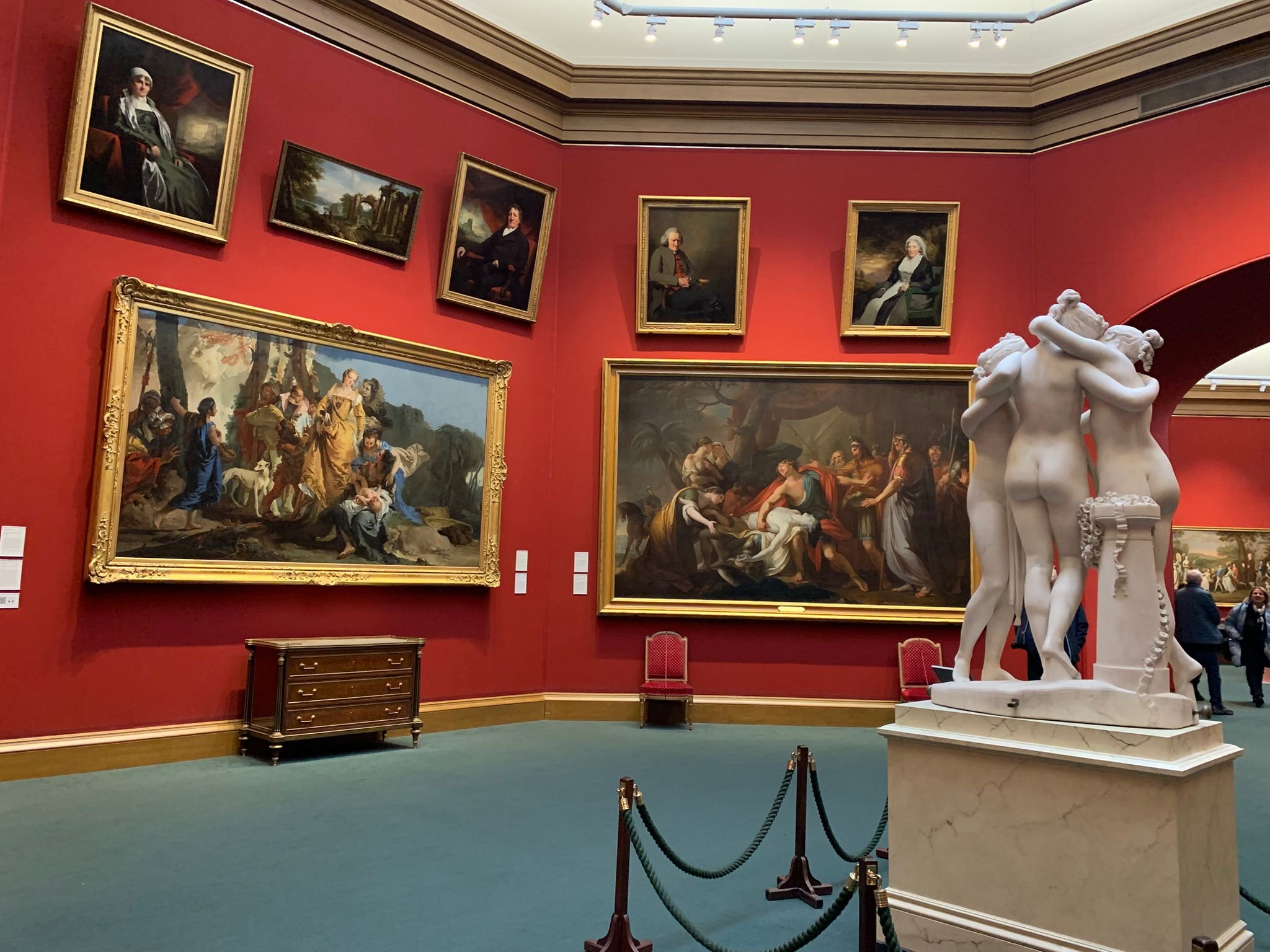
A monumental room, where art becomes architecture: red walls like velvet, gilded frames like thresholds and marble at the centre turning the whole gallery into a staged encounter.
The ceiling height and cornicing further reinforce hierarchy. Monumental works are granted vertical space, allowing the eye to travel upward, while smaller paintings cluster at more intimate viewing heights. This vertical rhythm echoes Romanticism’s own obsession with scale - with the smallness of the human figure against vast natural or historical forces. Even the placement of benches and barriers subtly choreographs, how long the viewer is expected to stay, where they are invited to pause and where they are encouraged to move on.
Importantly, the gallery does not present Romanticism as a single, unified vision. Instead, it allows contradiction to surface. Idealised pastoral scenes coexist with images marked by unease or ambiguity. The room becomes less a shrine to beauty than a map of competing ways of seeing the world during a century defined by acceleration and rupture.
Seen together, these works, and the way they are installed, argue that Romanticism is not an escape from reality, but a response to it. Nature becomes a site onto which political, philosophical and emotional anxieties are projected. The Scottish National Gallery’s layout makes this argument spatially, rather than textually. Meaning emerges through proximity, scale and movement.
What remains with me after leaving the room is not a single image, but a bodily memory: the sensation of standing between a roaring waterfall and a silent marble figure, between painted storms and quiet interiors. The gallery does not resolve these tensions. It lets them coexist. And in doing so, it reminds us that nineteenth-century art was never merely about beauty - it was about how to live in a world that no longer felt stable.
