A gilded frame suggests certainty, as if beauty can be pinned down and kept. Monet won’t let that happen. In front of Poplars on the Epte, I’m not looking at something settled - I’m looking at air and passing time. The paint shivers, alive with a light that keeps changing its mind.
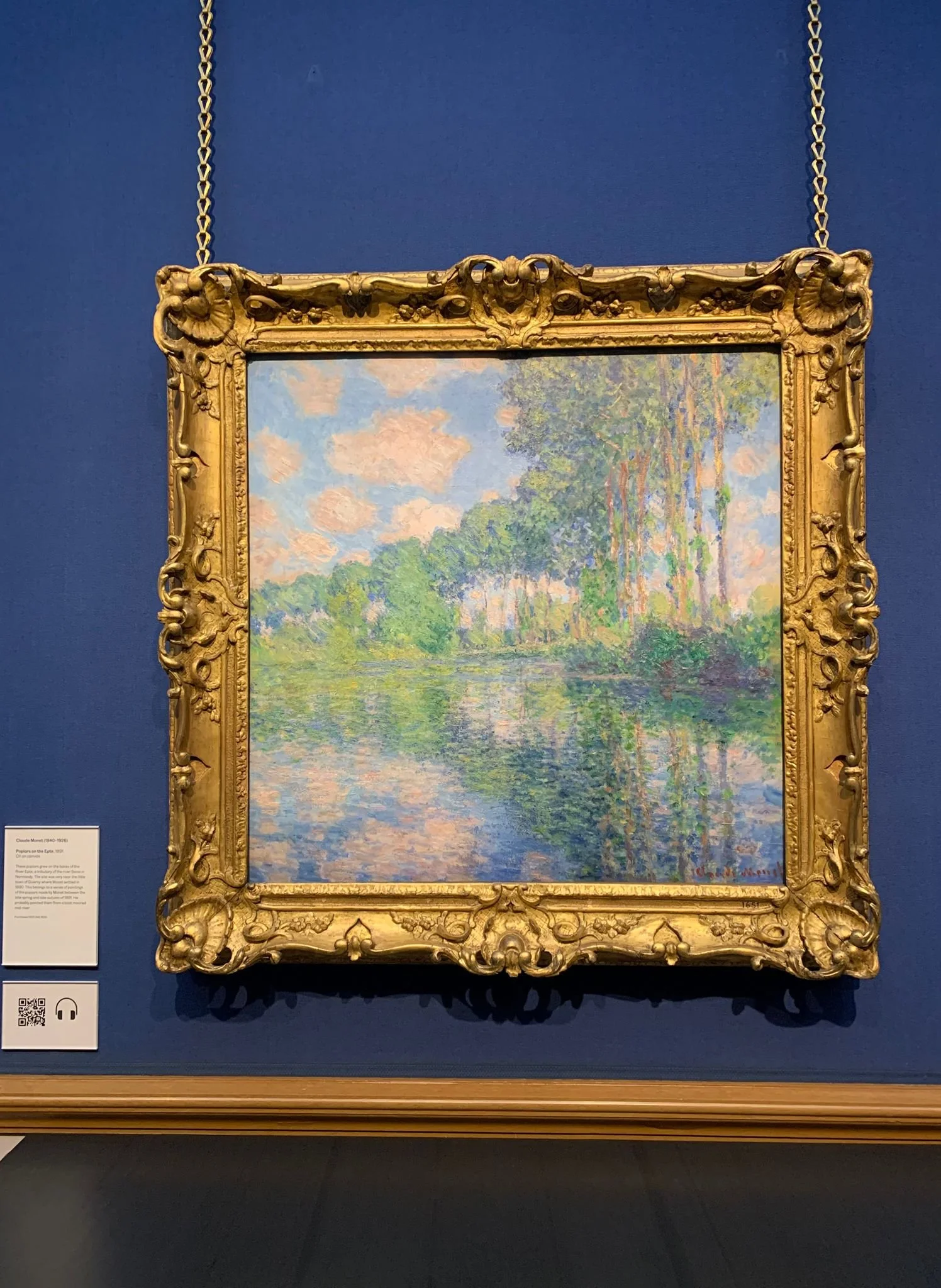
Claude Monet
Poplars on the Epte
1891, oil on canvas
Painted near Giverny on the River Epte, this work is part of Monet’s Poplars series, capturing shifting light and atmosphere through broken, luminous brushstrokes.
Scottish National Gallery, Edinburgh
This painting was born outdoors - on the River Epte, near Limetz-Villez, only a short distance from Monet’s home in Giverny. He worked from a floating studio, a boat fitted to steady canvases, while the river moved under him, as if the act of painting had to accept drift in order to speak truthfully about seeing. Today, Poplars on the Epte (1891) lives on through museum collections and scholarship, and I encountered it in Edinburgh at the Scottish National Gallery, where it is preserved, studied and continually re-seen.
At first glance, the motif seems modest: trees, sky, water. Yet the poplars rise like vertical sentences - tall, slender, almost too bright - set against a sky that breaks into soft clouds, and then broken again into brushstrokes. The river below is not a “reflection” in the polite, mirror-like sense. It is a second painting happening at the same time. Water does not repeat the world - water translates it. Monet paints that translation: sky becoming ripple, tree becoming vibration, form becoming a rumor.
As an art historian, I’m always listening for how a painting organizes time - what it asks the eye to do, how it trains your attention. Here, time is not narrated, it is scattered. The brushwork lays down small decisions - greens that lean into blue, pinks that flare inside pale cloud, lilacs that appear, where you expected shadow - until the scene feels less like a location and more like a condition: the condition of looking, the condition of light passing.
This is where Impressionism stops being a label and becomes a philosophy. Impressionism, at its core, was built on the attempt to record nature through the fugitive effects of colour and light, to paint what the eye receives in a given moment, rather than what tradition insists should be there. The Impressionists’ “casual” brushwork often hides careful structure and their shadows refuse the old black-and-brown conventions, turning instead into colour, because light contaminates everything it touches. Monet doesn’t simply show poplars, he shows the instability of poplars in sunlight, the way a tree can feel solid one second and then, under a certain glare, become almost pure atmosphere.
And yet there is something wonderfully practical, even urgent, behind this shimmering softness. Monet’s poplars were not eternal. They belonged to the commune and were put up for auction, while he was still working, forcing him into an almost surreal solution: he arranged to buy the trees (through a timber merchant), so they would remain standing long enough for him to finish painting them. In other words, the subject had a deadline. The landscape was scheduled for disappearance. That knowledge lives in the paint like a quiet pressure: not panic, but insistence. Look now.
Historically, this urgency sits inside the broader mood of late nineteenth-century France - years that later generations would mythologize as la belle époque, an age remembered for confidence and cultural flourishing before the rupture of 1914. France under the Third Republic carried a vast colonial empire and the restless self-image of modernity, even as artists like Monet turned away from grand history painting and toward the everyday theatre of perception: water, air, a line of trees along a riverbank. It’s a paradox of the period: a world expanding outward through power and industry, while a painter narrows his gaze until the smallest shift in light becomes monumental.
That is the final seduction of this work. It doesn’t ask you to admire a place. It asks you to inhabit a moment. The poplars stand there, yes, but they also dissolve, reassemble, and dissolve again, as if Monet has painted not the river, not the trees, but the fragile agreement between your eye and the world. And when you step away, you carry that lesson with you: that reality is not stable and beauty is often just attention, held long enough to see the sky learning itself in water.
