There are paintings that present themselves at once and there are paintings that ask us to remain. The Reptile House belongs to the second kind. It does not open itself through clarity, but through atmosphere, not through certainty, but through unease. It is a work that seems less painted than condensed, as if a whole environment of tension, memory and urban estrangement had gathered itself into pigment. In front of it, one does not simply look. One adjusts. One lingers. One enters its climate.
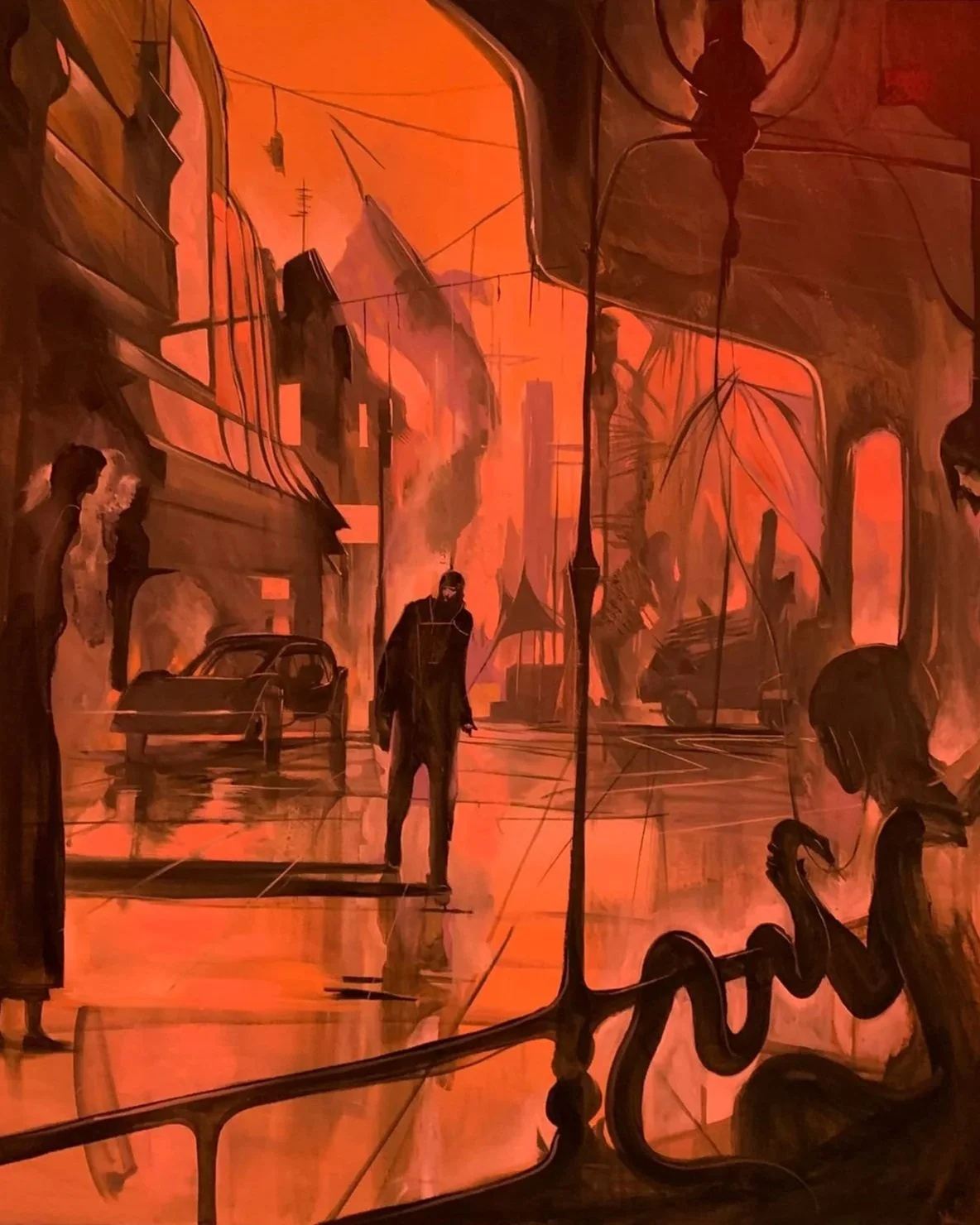
At first, the painting appears to offer a city. We find architectural fragments, a wet reflective ground, vehicles, hanging lines and figures dispersed across a compressed urban field. Yet this is not a city described in documentary terms. It is a city dissolved and reassembled through sensation. Space bends. Structures seem at once solid and melting. The built environment no longer functions as stable setting, but as psychological extension. Architecture here does not shelter, it hovers, drapes, looms. It becomes almost organic, as though the city itself had acquired skin, nerves and instinct.
This instability is one of the painting’s most powerful achievements. Will Baras does not construct perspective in the classical sense, where space reassures the viewer by yielding to order. Instead, he offers a space that slips between legibility and collapse. Streets open forward, but also seem to close in. Vertical forms suggest pillars, cables, tendrils or skeletal remains. The eye moves through the image only to discover that movement itself is uncertain. In this way, The Reptile House stages a crisis of orientation. It gives us the visual language of the city, but deprives that language of its promise of coherence.
What is more, the title sharpens this experience. A reptile house is, traditionally, a place of containment: an architectural enclosure built to hold what is cold-blooded, ancient, alert and not fully familiar. To call this painting The Reptile House is to suggest that what we are seeing is not merely an urban scene, but an ecosystem of instinct. The city becomes terrarium. Its inhabitants appear watched as much as watching. The black, serpentine forms that curve through the lower right corner are especially important here. They are not simply decorative gestures. They function as a visual principle: the reptilian made structural, the animal translated into line. Their presence contaminates the whole scene, so that even architecture begins to seem scaled, slithering, predatory.
This is where the painting becomes art-historically rich. Its atmosphere recalls, in one sense, the legacy of Expressionism, where external form is bent to inner pressure. But Baras does not merely inherit expressionist distortion, he relocates it into a contemporary urban imaginary shaped by cinematic disquiet, post-industrial ruin and speculative fiction. The city in The Reptile House is not the heroic modern metropolis of early twentieth-century painting. It is a city after confidence. Its structures remain, but their ideological certainty has drained away. What persists is mood: isolation, threat, estrangement and a strange beauty born from collapse.
Furthermore, the chromatic field is central to this effect. The painting is saturated with orange, rust, ember and bruise-dark black. These are not naturalistic colors. They belong to a world overheated, fevered and suspended between sunset and emergency. Orange here is deeply ambiguous. It can suggest light, heat, danger, combustion, even contamination. It fills the canvas not as illumination, but as pressure. Against it, the black forms become silhouettes, wounds or residues. The result is a palette that evokes both seduction and alarm. We are drawn in by warmth, only to discover that this warmth burns.
Moving on to the next point, the treatment of the figure intensifies this ambiguity. Human presence in the painting is undeniable, yet humanity is not its center. The standing figure near the middle appears isolated, almost arrested, less a protagonist than a witness or leftover trace. Other figures at the margins feel ghosted into being, never fully stabilized. This withholding matters. Baras resists portraiture in favor of apparition. In other words, the figures are there, but they do not claim the painting, they are vulnerable to it. The world exceeds them. In that sense, The Reptile House participates in a long visual tradition in which modern life is represented not through social narrative alone, but through the smallness of the human before systems, structures and moods it cannot master.
And yet the painting is not only dystopian. What makes it compelling is that it does not collapse into illustration. It remains painterly in the fullest sense. Washes, drips, veils and sweeping black gestures insist on the material intelligence of the medium. Acrylic and ink are not simply vehicles for image, they become part of the meaning. Ink lends the work its nervous linearity, its stains and sharp incursions. Acrylic builds atmosphere, fog and reflective density. Together they produce a visual language in which precision and dissolution coexist. The world appears both, drafted and eroded, both designed and decaying.
This material tension mirrors a deeper conceptual one: the conflict between structure and instinct, enclosure and seepage, civilization and something older that persists beneath it. That, perhaps, is the deepest force of the painting. It suggests that the modern city is never entirely modern. Beneath its surfaces remain older registers of fear, surveillance, territoriality and bodily vulnerability. Moreover, the “reptile” in the title is not only an image, but a condition. It names the primitive life that survives inside systems that imagine themselves rational. The painting asks, whether our cities have truly transcended those instincts, or whether they have merely given them new architecture.
What lingers, finally, is the work’s refusal to resolve itself. It does not tell us, whether we are looking at aftermath, prophecy, dream or memory. It occupies the unstable threshold between them. That uncertainty is not a weakness, but the source of its depth. The Reptile House understands that contemporary anxiety is rarely experienced as a single event. More often, it is atmospheric. It gathers in spaces, in reflections, in the feeling that the world remains intact, while something in it has quietly shifted.
So, to stand before this painting is to encounter a city that has become sentient in its unease. Its streets gleam, but not with hope. Its forms endure, but only by mutating. Its figures remain, but as fragile presences inside a world that seems to be watching them back. Baras gives us not a scene, but a condition of seeing: a way of understanding the urban image as haunted, porous and alive with submerged instinct.
And perhaps that is why the painting stays with us. It reminds us that art does not always offer answers. Sometimes it offers a climate, in which thought can deepen. Sometimes it allows us to feel, before we can explain, that beneath the surfaces of the contemporary world there are still ancient currents moving — silent, alert and difficult to name.
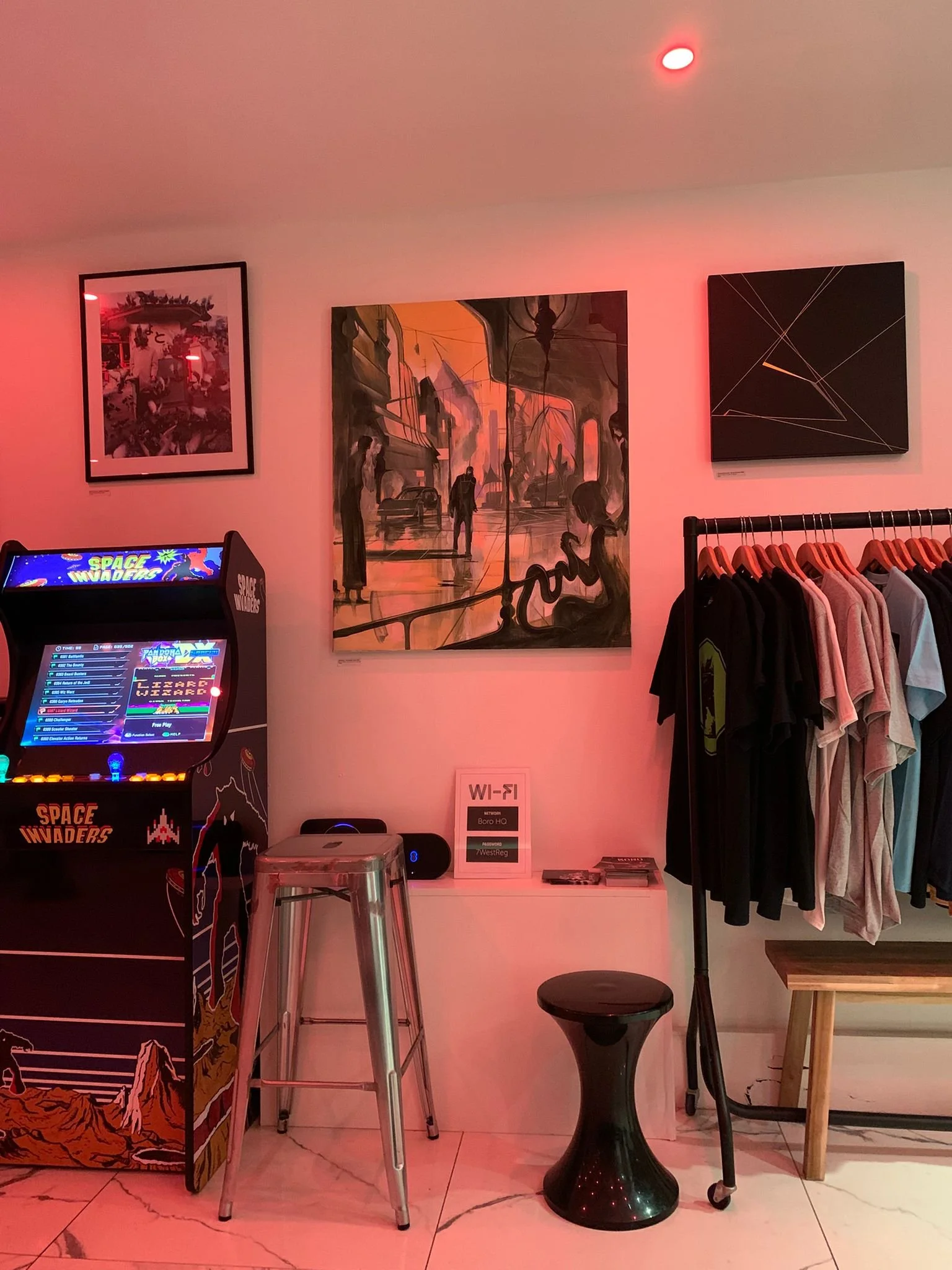
The work was viewed at BORO Gallery & Cafe Bar, 7 West Register Street, Edinburgh.
BORO. “BORO – Edinburgh – Art, Sounds, Drinks.” https://www.boroed.com/.
Benjamin, Walter. The Arcades Project. Translated by Howard Eiland and Kevin McLaughlin. Cambridge, MA: Belknap Press of Harvard University Press, 2002.
Berger, John. Ways of Seeing. London: British Broadcasting Corporation and Penguin Books, 1972.
Clark, T. J. The Painting of Modern Life: Paris in the Art of Manet and His Followers. Rev. ed. Princeton, NJ: Princeton University Press, 1986.
Crary, Jonathan. 24/7: Late Capitalism and the Ends of Sleep. London: Verso, 2013.
Edensor, Tim. Industrial Ruins: Space, Aesthetics and Materiality. Oxford: Berg, 2005.
Fisher, Mark. The Weird and the Eerie. London: Repeater Books, 2017.
Lefebvre, Henri. The Production of Space. Translated by Donald Nicholson-Smith. Oxford: Blackwell, 1991.
Ngai, Sianne. Ugly Feelings. Cambridge, MA: Harvard University Press, 2005.
Simmel, Georg. “The Metropolis and Mental Life.” In The Sociology of Georg Simmel, translated and edited by Kurt H. Wolff, 409–24. New York: Free Press, 1950.
Vidler, Anthony. The Architectural Uncanny: Essays in the Modern Unhomely. Cambridge, MA: MIT Press, 1992.
